
Retargeting Ads: How to Win Back Visitors Who Did Not Enquire
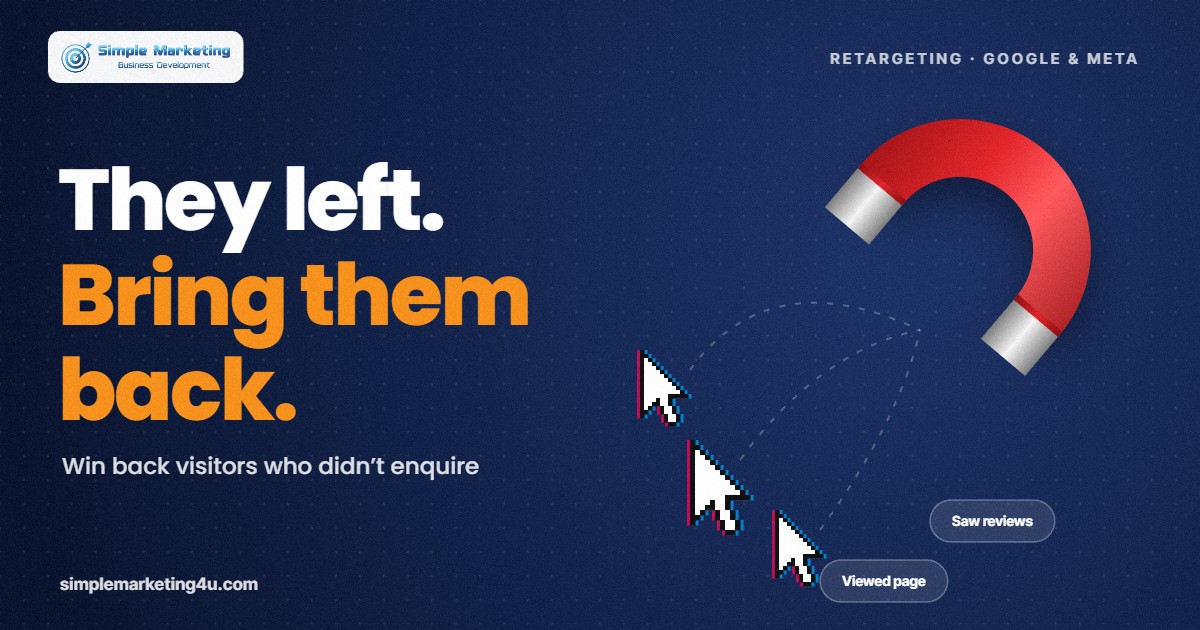
Retargeting shows ads to people who have already visited your website or engaged with your business. Most visitors do not enquire on their first visit. Retargeting on Google and Meta reminds them with reviews, offers and proof, bringing a share of them back to enquire. It is usually one of the most cost-effective campaigns because the audience already knows you.
Most people who visit your website leave without enquiring. They were interested, got distracted or wanted to compare. Retargeting brings your business back in front of them with the right message, so you are top of mind when they are ready to decide.
Key takeaways
- Retargeting reaches people who already know you.
- Use Meta and Google audiences together.
- Show reviews, proof and offers, not the same ad again.
- Limit frequency and exclude people who have already enquired.
- Respect cookie consent and privacy rules.
In this guide
- How retargeting works
- Audiences worth retargeting
- What to show them
- Avoid annoying people
- Part of a full funnel
- How to set up retargeting ads step by step
- How much does retargeting cost in Ireland?
- Retargeting ad ideas that work for local businesses
- How long should a retargeting window be?
- FAQ about retargeting
How retargeting works
When people visit your site or engage with your social profiles, Google and Meta can add them to audiences (with appropriate consent). You can then show them ads for a set period, such as 7 to 30 days.
Audiences worth retargeting
- Visitors to service or pricing pages.
- People who started but did not finish a form.
- Instagram and Facebook profile engagers.
- People who watched most of a video ad.
What to show them
- Reviews and testimonials from local customers.
- Before-and-after photos or case results.
- A time-limited offer or a reason to act now.
- Answers to common objections, such as price or timing.
Avoid annoying people
Set frequency limits, stop showing ads to people who have already enquired and refresh creative regularly. Make sure your cookie banner and tracking respect consent rules.
Part of a full funnel
Retargeting works best alongside prospecting campaigns on Google and Meta, a strong landing page and fast follow-up. We set up all of it as part of our paid ads management.
How to set up retargeting ads step by step
Retargeting only works if your tracking is right, so set it up in this order. Each step takes minutes, and together they turn a lost visitor into a second chance to win the job.
- Install the Meta pixel and Google tag on every page of your website, including thank-you pages, so both platforms can see who visited and who already enquired.
- Build your audiences: all visitors in the last 30 days, people who viewed a service page, people who started but did not finish a form, and people who watched 50% of a video ad.
- Exclude people who already converted so you do not pay to show “get a quote” ads to someone who just got one.
- Write ads for warm people: reviews, before-and-after photos, a reminder of your offer and an easy way to call or message.
- Cap the frequency so the same person does not see your ad ten times a day. Two or three times a week is plenty for most local businesses.
- Check results weekly by cost per enquiry, not by clicks.
How much does retargeting cost in Ireland?
Retargeting audiences are small, so the budget is small too. Many Irish local businesses spend somewhere around €3–€10 a day on retargeting alongside their main campaign. Because these people already know you, retargeting ads often produce some of the cheapest enquiries in the whole account. If you want to plan the full budget, see how much Facebook ads cost in Ireland and how much Google Ads cost in Ireland.
Retargeting on Google vs Meta
| Google retargeting | Meta retargeting | |
|---|---|---|
| Where ads show | YouTube, Gmail and partner websites | Facebook, Instagram and Messenger |
| Best for | Staying visible while people keep researching | Reviews, offers and visual proof of your work |
| Lead forms | Website only | Instant lead forms and messages |
For most small businesses we start with Meta retargeting because it is cheaper and supports instant lead forms, then add Google retargeting once search campaigns are running.
Retargeting ad ideas that work for local businesses
- Review ads: a screenshot of a five-star Google review with “See why Kilkenny homeowners choose us”.
- Before and after: one image showing the result you deliver.
- Offer reminder: “Your free quote is still available this week.”
- FAQ ads: answer the question that stops people booking, such as price, timing or mess.
- Team video: a 15-second clip introducing the person who will do the job.
Rotate two or three of these ideas so the same people do not see one ad over and over. Keep the call to action simple: call, message or fill in a short form.
How long should a retargeting window be?
The right retargeting window depends on how long customers take to decide. For urgent services such as plumbing or locksmiths, 7 to 14 days is enough. For considered purchases like kitchens, extensions, implants or orthodontics, 30 to 90 days works better because people compare quotes for weeks. Split your audiences by time, show a reminder ad to recent visitors and a review or offer ad to older ones, and always exclude people who have already enquired.
Losing visitors who never enquire?
We will set up retargeting on Google and Meta to bring them back, with offers and proof that convert.
FAQ about retargeting
What is retargeting?
Showing ads to people who have already visited your website or engaged with your business online.
Does retargeting work for small businesses?
Yes. It is often cost-effective because the audience already knows your business.
How long should I retarget visitors?
Commonly 7 to 30 days, depending on how long customers take to decide.
Is retargeting GDPR compliant?
It can be, when tracking respects cookie consent and privacy rules.
Can I retarget on both Google and Facebook?
Yes. Most campaigns use both for the widest reach.

Written by the Simple Marketing Business Development team
We are a Kilkenny-based digital marketing agency, voted Best Business Development & Marketing Consultants (Leinster) at the Irish Enterprise Awards. We run Google, Meta, LinkedIn and TikTok ads, build websites and set up CRM and follow-up systems for local businesses and online brands across Ireland. About us · Contact
Sources & references
- Google Ads Help, About your data segments
- Meta Business Help Centre, About website custom audiences
- Data Protection Commission (Ireland), guidance on cookies
Last updated: 17 November 2026
