
Small Business Marketing in Ireland: The Practical 2026 Guide
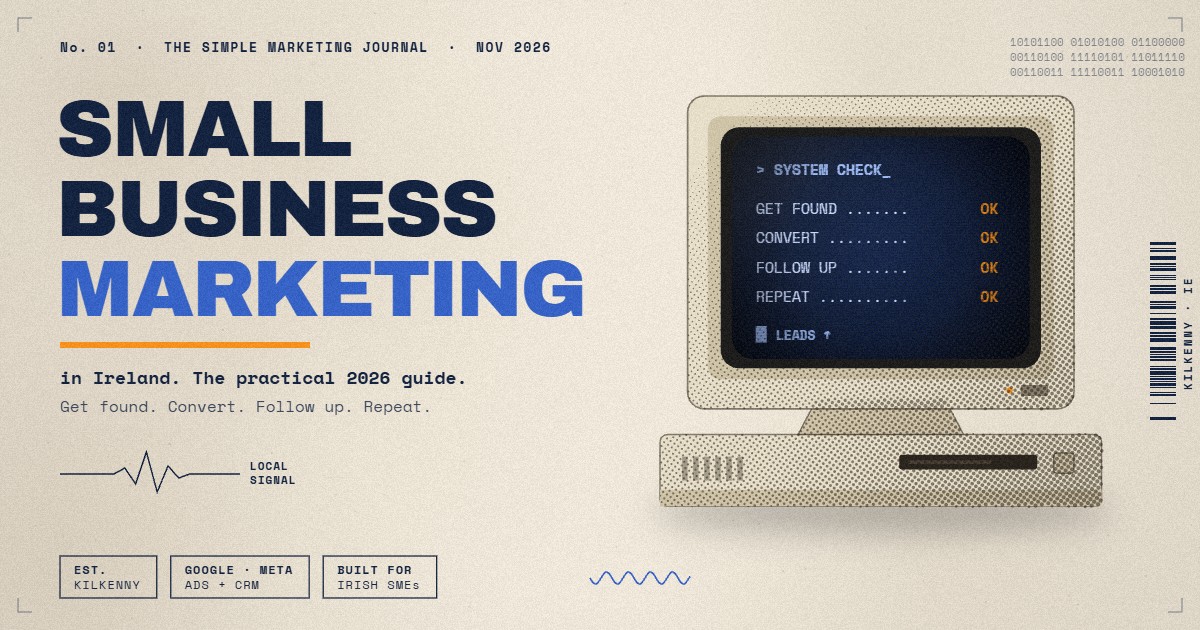
Small business marketing in Ireland works best as a simple four-part system: get found where local customers search (Google, Facebook, Instagram), turn visitors into enquiries with a clear website and offer, follow up every lead fast, then bring customers back with email, SMS and reviews. Start with one or two channels, track cost per lead, and scale only what pays.
If you run a small business in Ireland, you’ve probably had every bit of marketing advice going: be on TikTok, start a podcast, post every day, “do SEO”, run ads. All at once. That’s how good businesses burn through money and weekends.
We’ve spent years running campaigns for Irish trades, clinics, e-commerce stores and service firms from our base in Kilkenny, and we keep seeing the same thing: the businesses that grow aren’t doing the most marketing. They’re running a simple system and improving it every month.
So below, we’ll walk you through how to build that system: what to do first, what to spend, which channels suit which businesses, and how to tell if it’s actually working.
Key takeaways
- Treat marketing as a system: Get found → Convert → Follow up → Repeat. A weak link anywhere wastes the budget spent on every other step.
- Pick one or two channels where your buyers already are. For most local businesses that means Google search and Facebook/Instagram.
- Speed matters: firms that contact a lead within an hour are nearly 7x more likely to qualify it (Harvard Business Review).
- Eligible small businesses can claim up to €2,500 towards online trading projects through the Trading Online Voucher from their Local Enterprise Office.
- Measure cost per lead and cost per sale, not likes or impressions.
In this guide
- What is small business marketing (and why most of it fails)?
- The 4-part small business marketing system
- How much should a small business spend on marketing in Ireland?
- Can I get a grant for marketing my small business in Ireland?
- Which marketing channels work best for small businesses in Ireland?
- What results can a simple system deliver?
- Your 90-day small business marketing plan
- 7 small business marketing mistakes to avoid
- Do it yourself or hire help?
- FAQ about small business marketing in Ireland
What is small business marketing (and why most of it fails)?
Small business marketing is everything you do to attract, win and keep customers with a limited budget and a small team. For an Irish SME, that usually means a mix of a website, a Google Business Profile, paid ads, social media, email and word of mouth.
When it doesn’t work, it’s nearly always one of three things:
- No clear offer. “Quality service at competitive prices” isn’t an offer. “Free roof inspection within 48 hours in Kilkenny and Carlow” is.
- Leaks between steps. A business pays for clicks, but the website is slow, the form is buried, or nobody calls the lead back until Friday.
- No tracking. Without knowing what each enquiry costs, you can’t tell a channel that’s working from one that’s draining cash.
Fix those three and even a modest budget starts pulling its weight.
The 4-part small business marketing system
Think of your marketing as a pipeline. Every stage needs to work, because a leak at stage 3 wastes the money you spent on stage 1.
| Stage | Goal | Main tools | Number to watch |
|---|---|---|---|
| 1. Get found | Reach people who need what you sell | Google Ads, Meta Ads, Google Business Profile, SEO | Cost per click, reach |
| 2. Convert | Turn visitors into enquiries or sales | Website, landing pages, offers, booking forms | Conversion rate |
| 3. Follow up | Turn enquiries into paying customers | CRM, call-backs, SMS, automated email | Lead-to-sale rate |
| 4. Repeat | Win repeat business and referrals | Email marketing, SMS, reviews, retargeting | Repeat purchase rate, reviews |
Stage 1: Get found where your customers are already looking
Your customers usually fall into two groups:
- People already searching (“emergency plumber Kilkenny”, “dentist near me”). Google Search and your Google Business Profile capture this demand. These are usually the warmest leads you can buy.
- People who don’t know they need you yet but match your ideal customer. Facebook and Instagram ads are built for this. You put an offer in front of the right people in the right area.
And Irish customers are still glued to social media: DataReportal counted 4.57 million social media user identities in Ireland in October 2026, about 85% of the population. That doesn’t mean you need every platform. It just means your customers are reachable, so choose the platform that matches how they buy.
Here’s the rule of thumb we use with clients:
- Local services and trades: Google Search + Google Business Profile first, then Facebook/Instagram lead ads. (See our guide to Facebook ads for tradesmen.)
- E-commerce: Meta ads and Google Shopping/Performance Max, supported by email.
- B2B services: LinkedIn plus Google Search for high-intent terms.
Stage 2: Convert visitors into enquiries
Traffic is worth nothing if it doesn’t turn into enquiries. Before you spend another euro on ads, check your website against this list:
- It loads quickly on a phone (most of your visitors are on mobile).
- The first screen says what you do, where, and for whom, with one clear call to action.
- Your phone number is tap-to-call and visible without scrolling.
- Forms ask only what you need (name, phone, service, area).
- Reviews and real photos of your work sit close to the call to action.
- Tracking is set up for calls and form submissions (Google Analytics 4, Google Tag Manager and the Meta Pixel).
For paid campaigns, a dedicated landing page for each offer nearly always beats sending people to your homepage. It’s the single most common fix we make in new client accounts. Our website design and development team builds pages like this with tracking set up from day one.
Stage 3: Follow up fast (where most profit is lost)
This is the part most people skip, and it’s the cheapest part of small business marketing in Ireland to fix.
In a well-known Harvard Business Review audit of 2,241 US companies, only 37% responded to an online enquiry within an hour, and 23% never responded at all. Firms that made contact within an hour were nearly seven times more likely to qualify the lead than those that waited even an hour longer.
What that means for you:
- Call or text new leads within minutes, not days.
- Use an automatic SMS and email reply so every enquiry gets an instant response, even at 9pm.
- Keep every lead in one place, a simple CRM, so nothing slips through the cracks.
- Follow up more than once. Many sales happen on the second, third or fourth contact.
This is why we set up CRM systems, SMS campaigns and AI chatbots for clients: they plug the leak between “enquiry” and “paying customer”.
Stage 4: Bring customers back
Winning a new customer costs far more than keeping one you already have. Once someone has bought from you:
- Ask for a Google review while the job is fresh, ideally with an automatic text.
- Add them (with consent) to an email list for seasonal offers, reminders and updates. Our email marketing service handles this for you.
- Use retargeting ads to stay visible to past visitors and customers.
- Reactivate old leads. Many businesses have hundreds of past enquiries in their phone or inbox that were never followed up.
A note on compliance: in Ireland, electronic direct marketing by email and SMS is covered by GDPR and the ePrivacy Regulations (S.I. 336 of 2011), enforced by the Data Protection Commission. Get clear consent, honour opt-outs immediately, and don’t buy lists.
How much should a small business spend on marketing in Ireland?
There’s no single right number, but there is a right way to work it out. Start from what a customer is worth to you, not from an arbitrary budget.
Step 1: Work out your allowable cost per customer. If an average job brings in €1,500 gross profit and you’re happy to spend 20% of that to win it, you can afford €300 per new customer.
Step 2: Work back to cost per lead. If you close 1 in 3 enquiries, you can afford €100 per lead.
Step 3: Set a test budget. To get enough data to judge a channel, aim for roughly 15–30 leads in your first month or two. At €100 per lead, a €1,500–€3,000 test across two months would be reasonable. At €30 per lead, far less.
For context, Irish agency Matrix Internet suggests a realistic starting Google Ads budget of €300–€500 per month for most Irish SMEs, with competitive sectors such as legal needing €2,000 or more. Our full breakdown is in How Much Does Google Ads Cost in Ireland?
One more thing: there are usually two costs: ad spend (paid to Google or Meta) and management (paid to whoever runs the campaigns). Ask for both separately in any quote.
Can I get a grant for marketing my small business in Ireland?
Yes, for some projects. The Trading Online Voucher Scheme, run through your Local Enterprise Office (LEO), offers up to €2,500 (ex VAT) with 50% co-funding from the business to help small firms trade more online.
According to LEO guidance, applicants typically need to:
- Have 10 or fewer employees and turnover under €2 million
- Have been trading for at least 6 months
- Be located in the area of the LEO they’re applying to
- Attend a Trading Online information seminar
Important: the scheme is competitive, and no spending should happen before LEO approval. Contact your Local Enterprise Office first. Ask about the Grow Digital Voucher too, which supports digital tools and software.
Which marketing channels work best for small businesses in Ireland?
| Channel | Best for | Speed to results | Typical role |
|---|---|---|---|
| Google Search Ads | Services people actively search for | Days | Capture high-intent demand |
| Google Business Profile | Any local business | Weeks | Free local visibility and reviews |
| Facebook & Instagram Ads | Trades, clinics, hospitality, e-commerce | Days | Create demand in a defined area |
| LinkedIn Ads | B2B, recruitment, professional services | Weeks | Reach decision-makers |
| SEO & blog content | Businesses with a long-term view | Months | Compounding free traffic |
| Email & SMS | Any business with past customers | Days | Repeat sales, reminders, reactivation |
| Social media (organic) | Brand trust and community | Months | Proof, personality, retention |
You don’t need all of them. Really. Most of our local clients get the bulk of their results from two paid channels plus strong follow-up.
What results can a simple system deliver?
When the four stages are connected, the numbers can change quickly. A few results from our own client work:
- Dublin landscaping company: €600 ad spend generated 90 leads and over €50,000 in revenue in one month.
- Roofing company: €800 ad spend brought 102 pre-qualified leads and €65,000 in revenue in one month.
- Feature walls company: €50,000+ in confirmed sales from one month of ads on a €500 budget.
- E-commerce store: €1,000 ad spend generated €20,000 in revenue in a single month.
Results vary by market, offer and season, and no honest marketer can guarantee them. But the common thread is simple: each business had a clear offer, a page built to convert, and fast follow-up. You can read what clients say in their own words on our testimonials page.
Your 90-day small business marketing plan
Foundations (days 1–30)
- Define one core offer and your ideal customer.
- Claim and complete your Google Business Profile; ask your last 10 happy customers for reviews.
- Fix the website basics (mobile speed, clear call to action, tap-to-call).
- Install tracking: GA4, Google Tag Manager, Meta Pixel and call tracking.
Launch and learn (days 31–60)
- Launch one paid channel (Google Search or Meta lead ads) with a defined test budget.
- Set up instant SMS/email replies and a simple CRM pipeline.
- Review search terms and audiences weekly; cut what doesn’t convert.
Optimise and expand (days 61–90)
- Double down on the ads, keywords and audiences with the lowest cost per lead.
- Start an email or SMS campaign to past customers.
- Add a second channel only once the first is profitable.
7 small business marketing mistakes to avoid
- Boosting posts instead of running proper campaigns. “Boost” buttons optimise for engagement, not enquiries.
- Sending ad traffic to your homepage. Use focused landing pages.
- Ignoring negative keywords. Without them you pay for irrelevant searches. We cut wasted spend for new clients by adding negative keywords and exclusion audiences.
- Slow follow-up. A lead that waits until tomorrow often goes to the competitor who answered first.
- Changing everything at once. Test one variable at a time.
- Chasing vanity metrics. Reach and likes don’t pay wages. Track cost per lead and revenue.
- Locking into long contracts before seeing results. Look for transparent reporting and flexible terms.
Do it yourself or hire help?
DIY makes sense if you have the time, enjoy learning the platforms and have a small budget. Hiring a marketing consultant or agency makes sense when your time is better spent running the business, when ad spend is large enough that mistakes are expensive, or when you’ve tried DIY and hit a ceiling.
Not sure where your own setup is leaking? Our team in Kilkenny offers a free strategy session. We’ll look at where your leads come from, where they leak and what we’d fix first. No hard sell, just straight answers.
Want a marketing system that brings in steady enquiries?
Simple Marketing Business Development was voted Best Business Development & Marketing Consultants (Leinster) at the Irish Enterprise Awards. Based in Kilkenny, we work with businesses across Ireland on paid ads, websites and customer follow-up.
FAQ about small business marketing in Ireland
What is the best marketing for a small business in Ireland?
For small business marketing in Ireland, the best mix for most local businesses is Google Search ads and a complete Google Business Profile to capture people already searching, plus Facebook and Instagram ads to reach new customers in your area. Back this up with fast follow-up and email or SMS to win repeat business.
How much should a small business spend on marketing?
Work backwards from customer value. Decide what you can afford to pay for a new customer, divide by your closing rate to get an affordable cost per lead, then budget for 15–30 leads to test a channel. Many Irish SMEs start Google Ads at around €300–€500 per month, plus management.
Is there a grant for small business marketing in Ireland?
The Trading Online Voucher from your Local Enterprise Office offers up to €2,500 (ex VAT, 50% co-funded) for eligible small businesses with 10 or fewer employees that have traded for at least six months. Approval is competitive, and you must not spend before you’re approved.
How long does small business marketing take to work?
Paid ads can generate enquiries within days of launch, though campaigns usually need a few weeks of data to optimise. SEO and organic social media are slower, typically several months, but they compound over time.
Should I use Google Ads or Facebook Ads?
Use Google Ads when people actively search for your service, and Facebook/Instagram ads when you need to create demand or reach a defined local audience with a visual offer. Many businesses get the best results using both.
Do I need a website if I have a Facebook page?
Yes. A website you own builds trust, converts ad traffic better, ranks on Google and lets you track results properly. Social platforms can change their rules or reach overnight. Your website and email list are assets you control.
What are small business marketing services?
Small business marketing services cover the work needed to win and keep customers: paid ads on Google and Meta, websites and landing pages, social media management, email and SMS campaigns, CRM setup and reporting. Most small businesses in Ireland buy a combination rather than a single service.
What is online marketing for small businesses?
Online marketing for small businesses means using digital channels such as Google search, your Google Business Profile, Facebook and Instagram, email and your website to get found, generate enquiries and win repeat sales. Because it is measurable, you can see exactly what each enquiry costs.
What is a small business marketing system?
A small business marketing system is a repeatable process that connects getting found, converting visitors, following up leads and bringing customers back. Instead of one-off campaigns, each step feeds the next, so your results become predictable month after month.

Written by the Simple Marketing Business Development team
We are a Kilkenny-based digital marketing agency, voted Best Business Development & Marketing Consultants (Leinster) at the Irish Enterprise Awards. We run Google, Meta, LinkedIn and TikTok ads, build websites and set up CRM and follow-up systems for local businesses and online brands across Ireland. About us · Contact
Sources & references
- DataReportal, Digital 2027: Ireland (data October 2026)
- Harvard Business Review, “The Short Life of Online Sales Leads” (Oldroyd, McElheran & Elkington, 2011)
- Local Enterprise Office, Trading Online Voucher Scheme
- Matrix Internet, How much should an Irish SME spend on Google Ads?
- Data Protection Commission, Rules for electronic direct marketing
Last updated: 15 November 2026
